
The Jevons Paradox: Why Efficiency Can Lead to More Consumption
In the world of sustainability and economics, there is a counterintuitive phenomenon that challenges our common sense: The Jevons Paradox. It suggests that as we become more efficient at using a resource, we might actually end up consuming more of it, not less.
What is the Jevons Paradox?
The Jevons Paradox occurs when technological progress increases the efficiency with which a resource is used, but the falling cost of use induces so much new demand that the total consumption of that resource rises.
The Mechanism: The Rebound Effect
The core of the paradox lies in the Rebound Effect:
- Efficiency Increases: A technology allows us to get more output from the same amount of input (e.g., fuel).
- Effective Cost Drops: The cost of using that resource (per unit of service) decreases.
- Demand Surges: Lower costs encourage consumers to use the resource more frequently or find entirely new ways to use it.
- Backfire: If the increase in demand outweighs the efficiency gains, total consumption increases (known as “backfire”).
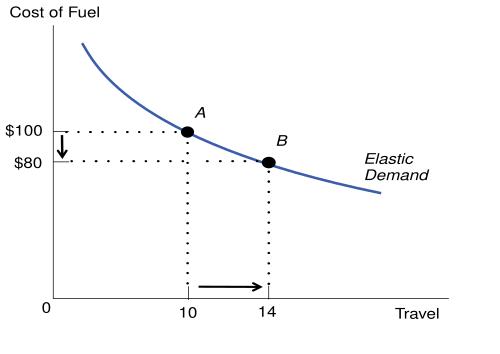
Elastic Demand: A 20% increase in efficiency causes a 40% increase in travel. Fuel consumption increases and the Jevons paradox occurs.
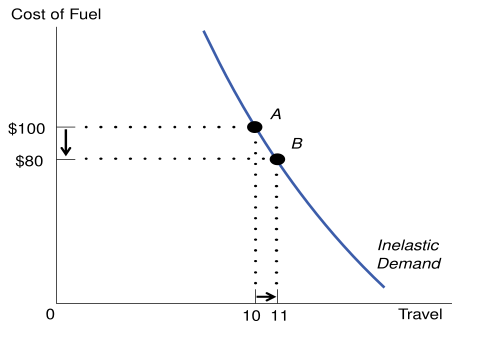
Inelastic Demand: A 20% increase in efficiency causes a 10% increase in travel. The Jevons paradox does not occur.
The Role of Elastic Demand
The “paradox” relies heavily on the economic principle of Price Elasticity of Demand.
- Definition: Price elasticity measures how much the quantity demanded of a good responds to a change in the price of that good.
- The Connection: When a technology becomes more efficient, the “effective price” of the service it provides (like light, heat, or travel) drops.
- The Result: If the resource has Elastic Demand (where a small drop in price leads to a large increase in usage), consumers will increase their consumption so significantly that it offsets any gains made by the efficiency.
Historical Context: The Coal Question
In 1865, economist William Stanley Jevons observed that James Watt’s steam engine—which was far more coal-efficient than its predecessors—actually led to an increase in England’s total coal consumption. Because the engines were efficient, they became profitable for thousands of new applications, causing demand to explode.
Elastic vs. Inelastic Scenarios
| Scenario | Demand Type | Resulting Consumption |
|---|---|---|
| Inelastic Demand | Necessity (e.g., salt) | Consumption stays flat; Efficiency leads to true savings. |
| Elastic Demand | Growth Sector (e.g., data, air travel) | Consumption surges; Efficiency leads to the Jevons Paradox. |
| “Backfire” Effect | High Elasticity | Total resource use exceeds the pre-efficiency levels. |
Modern Examples
- Fuel-Efficient Cars: When cars get better gas mileage, the cost per mile drops. This often encourages people to drive longer distances or choose larger vehicles (SUVs), offsetting the fuel savings.
- LED Lighting: As lighting became incredibly cheap and efficient with LEDs, we didn’t just save energy; we started lighting up buildings, streets, and signs more than ever before.
- Digital Storage: As storage became 1,000x more efficient and cheaper, we didn’t save space—we started saving 4K videos, thousands of photos, and massive datasets that weren’t possible before.
- Computing Power: As processors become more energy-efficient, the cost of data processing drops, which fuels the growth of energy-intensive AI, big data, and cloud computing.
Conclusion
Efficiency is a tool, not a solution on its own. If a resource has highly elastic demand, technological efficiency must be paired with policy-driven conservation (like carbon taxes or quotas) to prevent the “backfire” of increased consumption.
Reference
- Wikipedia contributors. (n.d.). Jevons paradox. In Wikipedia, The Free Encyclopedia. Retrieved March 29, 2026, from https://en.wikipedia.org/wiki/Jevons_paradox
- Jevons, W. S. (1865). The Coal Question.
- 제번스의 역설. (n.d.). In *위키백과*. Retrieved March 29, 2026, from https://ko.wikipedia.org/wiki/제번스의_역설