
I architect and deploy large‑scale engineering platforms and commercial web solutions, managing complex codebases for semiconductor engineering and retail systems. I also develop experimental data‑driven methodologies using semiconductor, statistical, machine‑learning, and deep‑learning technologies to optimize semiconductor manufacturing across process, device, and yield development, all integrated into engineering platforms.
Alongside the large-scale platforms, I also developed lightweight engineering tools that function as microservices, as follows:
- Semiconductor TEG test and summary program, using HP-Basic on Linux
- Grapher: engineering charting and summary program, using C/C++ and Motif on Linux
- Gargamel: data extraction and transformation program, using C/C++ and MS-COM/MFC on MS-Windows
- Zimulator: Z-score simulator for SRAM bit cell, using HSPICE, Perl, and Motif on Linux
- Excel regressor: yield calculation program, using VBA on MS-Excel sheet
Integrated Data Analysis Platform
I launched the first in‑house software solution at Samsung Foundry to integrate foundry technology and data science, and I developed a web‑based platform from scratch to support diverse engineering data and enable emerging‑technology skill development.
When I developed the SRAM bit‑cell yield model at Samsung, I found it challenging to help engineers understand bit‑cell operation, statistics, and the long computational workflow involved. To address this, I developed an autonomous simulation tool called Zimulator, utilizing HSPICE, Perl, and Motif on Linux. It helped engineers 1️⃣ quickly learn both the old models and the new model, and 2️⃣ speed up computational pipelines. I faced a similar challenge later when analyzing embedded SRAM yield and logic yield, which led me to realize that I needed an engineering web platform to support this work.
So I took the initiative to launch a new software team with ownership over an integrated data and analysis (IDA) platform, designed to serve as an ecosystem for engineers. The platform was designed to automate control analysis and reporting through statistical analysis, machine learning, and deep learning techniques. I developed over 20 million lines of Python code for the research and development of the web platform. The platform had over 200 subscribers in the Samsung Foundry Technology Development team.
My in‑house software development followed a DevOps model. The process was agile because the developers understood both domains. The platform was built using Node.js, React, HTML, CSS, Bootstrap, jQuery, XML, JavaScript, Python, MongoDB, Docker, and Git.
Full-Stack Engineering Platform
I developed a full‑stack system (Y Rocket Station 🚀) using Flask and JavaScript for the frontend, with Python and MongoDB powering the backend. I also built automated pipelines in Python to perform statistical analysis and explore AI/ML techniques on large‑scale datasets. Since semiconductor manufacturing data was not available, I used publicly accessible daily stock market data as an open‑data substitute for experimentation and modeling.
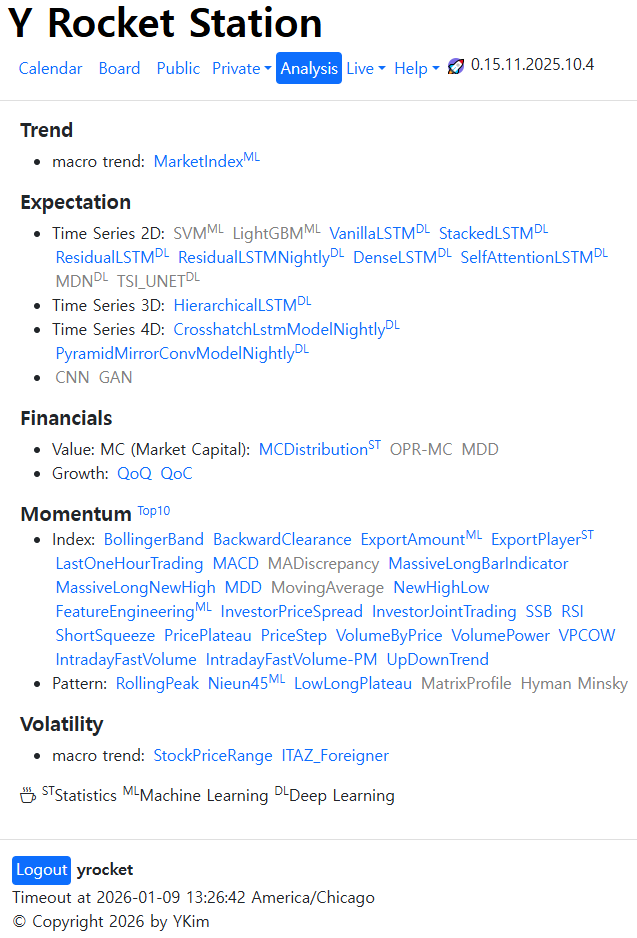
I managed the source code through GitHub and containerized both the MongoDB database and the Flask web application using Docker to ensure consistent, isolated, and reproducible execution environments. The platform used Flask, jQuery, Bootstrap, Redis, MongoDB, and Python.
Commercial Web Solution
I built a custom WordPress site using modern Content Management System (CMS) workflows to showcase my engineering and commercial work and explore advanced frontend techniques and AI-assisted development. The project includes:
- Self‑hosted WordPress environment on a Synology NAS to support my research — This Site
- Managed WordPress hosting on WordPress.com for the e-commerce site — StellaFire.com, StellaFireBeauty.com
- Custom PHP development for improved performance and refined layout design
- Responsive layout design using WordPress blocks
- Customized forum with enhanced editor features
- Reporting form
- Calendar events integration
- YouTube statistics integration
- Troubleshooting slug issues (MySQL)
- AI-assisted Development: Gemini, Copilot, Amazon Q/Kiro, Claude
This project highlights my ability to bridge backend infrastructure with frontend design, creating maintainable and scalable web experiences. The webpage used WordPress, PHP, JavaScript, MySQL, and Python.
Related Posts below (or view All Articles)
Categories = “Software”
AI-Native Startup
HTML Rendering Methods
Comparison of Node.js, Flask, and WordPress
Cracked Engineer
Taxonomy of Workflow Automation
AI Prompt Framework
Modular Prompt Engineering
Popular software tools for systematic AI prompt
Microservices in Semiconductor Fabrication
Coding Skills by Human–AI Contribution
