
What is the non-volatile SRAM technology?
Non-Volatile SRAM (nvSRAM) is a type of memory that combines the high speed and infinite endurance of standard Static RAM (SRAM) with the non-volatility of a “shadow” memory, such as an EEPROM cell. During normal operation, it functions exactly like a fast SRAM. However, when power is lost, it automatically copies the entire contents of the SRAM into the non-volatile cells, where the data is safely stored for decades. When power returns, the data is automatically restored from the non-volatile cells back into the SRAM [3].
1. Cell Structure and Operation
Due to the prompt’s constraints, no figures or schematics are included. The structure and operation are described below.
Cell Circuit Structure (Schematic Description)
A commercial nvSRAM cell, such as one using Infineon’s (formerly Cypress’s) SONOS (Silicon-Oxide-Nitride-Oxide-Silicon) technology, is a hybrid cell. It consists of two main parts paired one-to-one for every bit of data [7]:
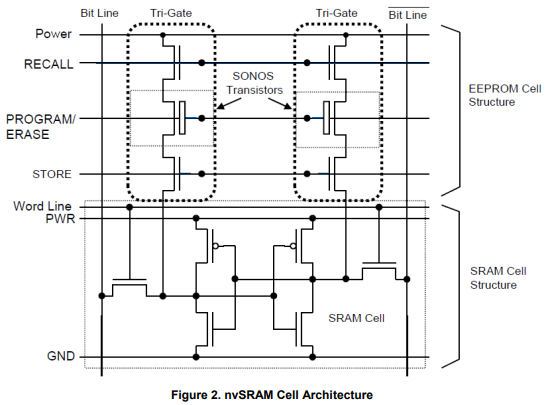
- The SRAM Cell: This is a standard 6-transistor (6T) CMOS SRAM cell. It is composed of two cross-coupled inverters (each made of one PMOS and one NMOS transistor) that form a latch to store one bit (a ‘0’ or a ‘1’). Two additional NMOS “access” transistors connect this latch to the bit-lines (BL and BL-bar) and are controlled by the word-line (WL). This 6T structure is volatile, meaning it holds data only as long as power is supplied.
- The Non-Volatile (NV) Element: This is the “shadow” cell that provides non-volatility. In SONOS technology, this is essentially a special non-volatile transistor (sometimes called a QuantumTrap cell) [2]. This NV element is connected to the storage nodes (the outputs of the two inverters) of the 6T SRAM cell. This SONOS transistor can store charge in a silicon nitride layer, which is an insulator, allowing it to hold its state (representing the ‘0’ or ‘1’) without any power [1].
Cell Layout Description
In the physical layout of the integrated circuit, the nvSRAM cell is designed for density. The 6-transistor SRAM cell is laid out as a standard, compact 6T cell. The non-volatile SONOS element is often fabricated directly above or adjacent to its corresponding SRAM cell, allowing for a highly parallel, one-to-one connection. This tight integration is what enables the entire memory array to be copied from the SRAM to the NV cells (a STORE operation) simultaneously and very quickly [7].
Cell Operation
The cell has three primary modes of operation:
- Normal Operation (SRAM Access):
- The device behaves identically to a standard high-speed SRAM.
- Read and write operations happen directly and only to the 6T SRAM cell latch.
- These operations are extremely fast (e.g., 20-45 ns access times) and have infinite endurance, meaning you can read and write to the SRAM cell an unlimited number of times without wearing it out [3].
- The non-volatile element is dormant and does not participate.
- STORE Operation (SRAM $\to$ Non-Volatile):
- This operation copies data from the volatile SRAM latch to the non-volatile “shadow” cell.
- A STORE is triggered in one of three ways:
- AutoStore: On-chip circuitry detects when the system power supply (Vcc) drops below a critical threshold. It automatically uses the energy from a small external capacitor (connected to a
VCAPpin) to complete the copy of the entire array to the NV cells before the chip powers down [2, 7]. - Software STORE: A user can send a specific command sequence to the chip to initiate a STORE.
- Hardware STORE: A dedicated pin on the chip can be toggled to trigger a STORE [3].
- AutoStore: On-chip circuitry detects when the system power supply (Vcc) drops below a critical threshold. It automatically uses the energy from a small external capacitor (connected to a
- This operation is slower (taking around 8 milliseconds for the whole array) and has a finite endurance (typically 1 million STORE cycles) [3, 2].
- RECALL Operation (Non-Volatile $\to$ SRAM):
- This operation copies data from the non-volatile cell back to the SRAM latch.
- It is automatically initiated every time the system powers on. The chip control logic reads the state of the non-volatile cells and forces the SRAM latches into that same state.
- This ensures that the system wakes up with the exact data it had at the moment of the last power failure [3, 7].
- RECALL operations, like read operations, have infinite endurance [2].
2. Key Features, Pros, and Cons
Key Features
- High Speed: Functions as a standard SRAM with fast access times (e.g., 20 ns to 45 ns) [3].
- Instant Non-Volatility: Data is automatically protected on power loss (AutoStore) without any software intervention [7].
- Battery-Free Solution: Unlike battery-backed SRAM (BBSRAM), it uses a small, simple external capacitor, eliminating the need for a battery. This reduces component count, cost, and environmental hazards, and removes the need for battery replacement [3].
- Standard Interfaces: Available in common memory interfaces like Serial (SPI) and Parallel [2, 3].
Pros
- Unlimited Read/Write Endurance: The SRAM part of the cell has infinite write endurance for normal operations, making it ideal for applications with frequent data changes, unlike Flash or EEPROM which wear out with every write.
- High Data Retention: Data stored in the non-volatile cells is typically retained for over 20 years, even at high temperatures [2].
- Simplified Design: As a drop-in replacement for SRAM (with the addition of one capacitor), it simplifies system design for data protection.
Cons
- Finite STORE Endurance: While reads and writes are infinite, the non-volatile STORE operation (copying from SRAM to NV cells) has a limited lifespan, typically 1 million cycles. This is a primary design consideration [2].
- Higher Cost: nvSRAM is generally more expensive per bit than traditional non-volatile memories like Flash or EEPROM due to its more complex hybrid cell structure.
- Lower Density: The hybrid cell (e.g., 6T SRAM + NV element) is larger than a simple Flash or F-RAM cell, leading to lower memory densities (i.e., fewer bits per chip).
3. Typical Applications
nvSRAM is ideal for any application that needs to log or cache data at high speed and ensure that data is never lost during an unexpected power failure.
- Industrial Automation: Storing machine status, process parameters, and critical logs in Programmable Logic Controllers (PLCs) [4].
- Data Storage: Used as a journal, cache, or metadata log in RAID storage controllers and Solid-State Drives (SSDs) to ensure no in-flight data is lost during a power outage.
- Aerospace and Defense: Storing critical boot code, mission data, and event logs in avionics and weapons systems that operate in harsh environments [4].
- Networking: Caching routing tables, system configurations, and event logs in high-performance routers and switches.
- Medical Devices: Recording patient data and system settings in life-critical equipment like patient monitors and infusion pumps.
4. Latest Commercial Product
The market for nvSRAM is mature, with Infineon Technologies (which acquired Cypress Semiconductor) being the primary manufacturer. While breakthrough products are less common than in emerging technologies, the “latest” generation focuses on higher reliability for harsh environments.
- Product: Infineon’s second-generation high-reliability nvSRAMs, including the 256 kb STK14C88C and 1 Mb STK14CA8C.
- Release Year: These products were announced on March 23, 2021 [4]. They are qualified for QML-Q (military-grade) and high-reliability industrial specifications, targeting aerospace, defense, and demanding industrial applications [4].
References
[1] EE Times. (2011, September 29). Advantages of SONOS memory for embedded flash technology. https://www.eetimes.com/advantages-of-sonos-memory-for-embedded-flash-technology/
[2] Infineon Technologies. (2024). 64-Kbit (8K × 8) SPI nvSRAM with QuantumTrap Technology [Datasheet]. https://www.infineon.com/dgdl/Infineon-CY14ME064Q2A-SXQ-DataSheet-v01_00-EN.pdf?fileId=8ac78c8c82ce56640182da87dd3d4934
[3] Infineon Technologies. (n.d.). PARALLEL NONVOLATILE SRAM (nvSRAM) [Product Brief]. https://www.infineon.com/dgdl/Infineon-Parallel_nvSRAM_Product_Overview-ProductBrief-v05_00-EN.pdf?fileId=8ac78c8c7d0d8da4017d0f656f8e521b
[4] Semiconductor For You. (2021, March 23). Infineon launches second-generation of high-reliability non-volatile SRAM. https://www.semiconductorforu.com/infineon-launches-second-generation-of-high-reliability-non-volatile-sram/
[5] Infineon Technologies. (2023, July 18). Infineon Introduces Automotive-Qualified F-RAM Memory Devices for Data Logging Expansion. https://news.europawire.eu/infineon-introduces-automotive-qualified-f-ram-memory-devices-for-data-logging-expansion/eu-press-release/2023/07/18/14/44/02/119086/
[6] Infineon Technologies. (n.d.). nvSRAM (non-volatile SRAM). https://www.infineon.com/products/memories/nvsram-non-volatile-sram
[7] Avnet. (n.d.). Nonvolatile SRAM (nvSRAM) Basics [White Paper]. https://www.avnet.com/wps/wcm/connect/onesite/0db0b52d-a739-4889-b69c-36bd41d846b1/nvSRAM-WhitePaper.pdf?MOD=AJPERES&CVID=lFRXY6c